Introduction.
When I was nineteen, I started the process of restoring the body of my 1990 Ford F-250. I had no prior experience with auto body work but I could not afford to have it professionally done and I’ve always enjoyed tinkering on vehicles so I thought I’d give it a shot. I knew my perfectionist tendencies would not allow me to accept subpar results and would also not allow me to leave the project unfinished once I had begun.
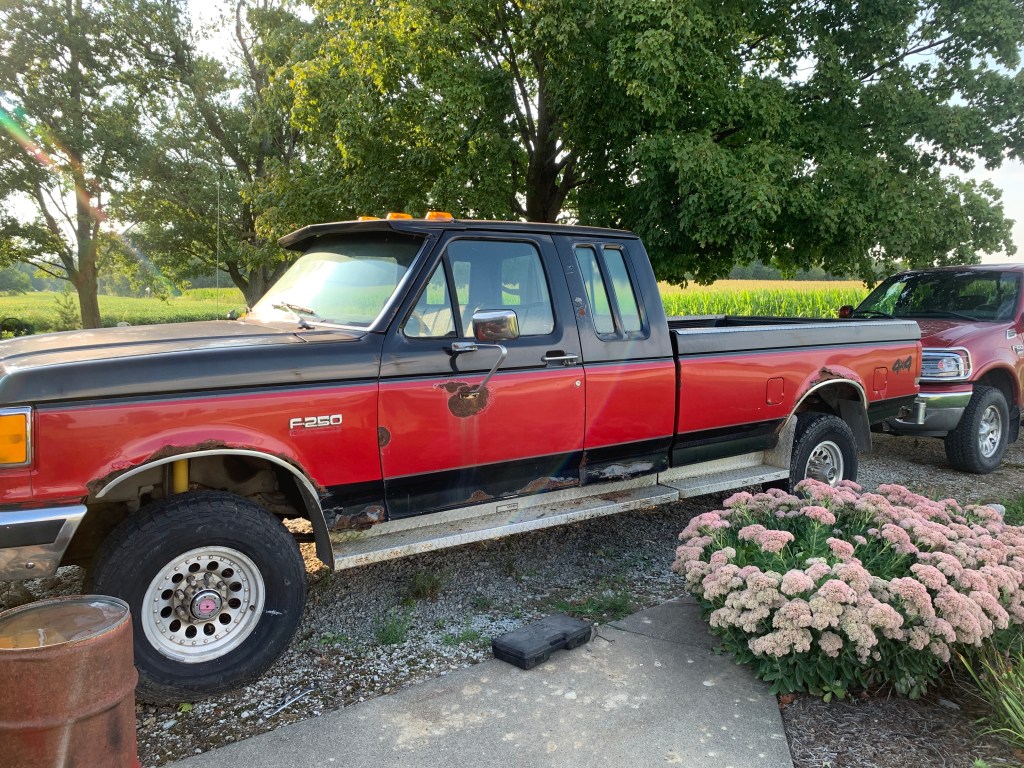
//My 1990 Ford F-250
So, with those assurances in mind, I started to work on it. I knew it was a big undertaking at the time, but I had no idea just how big it was. I wasn’t just setting out to fix dents or replace broken parts. It was the rust that had corroded my cab corners and ate away my fenders that I was on a quest to vanquish. Now, the thing that you have to understand about rust is that whatever you see on the outside, chances are there’s about twice as much underneath that has rusted away already. I’d had people tell me such things at the time but being the young man I was, I assumed that I could judge for myself how much rust there was…it would have been wiser to have not been so arrogant.
The project that I thought would involve replacing a couple doors, fenders, and welding some patches in cab corners turned into, removing the entire interior to patch holes in the floor of the cab, cutting out the lower half of the driver side door sill and rebuilding it completely, wire wheeling the entire frame down, patching rust holes in it, painting it, and building a new radiator core support just to name a few of the unforeseen tasks that I would go on to complete.
The “big” project that I was guessing would take 6 months or so at the time became a massive project that would end up taking about a year and a half. As of the writing of this, I still have not completed the project, but I am very near the end of it.
The purpose of this article is not to educate you on auto body terms or skills so don’t worry if you don’t know what a radiator core support is. Most people can live long and fulfilled lives without ever knowing that.
What is important and what I hope you can stand to gain from my experience are some of the principles and lessons that I learned from taking on such a massive project that could be useful to you so that when you undertake your own projects, you can avoid some of the regrets and missteps that I was unfortunate enough to fall into. Whether it be for work or a hobby, I think you can apply these principles and it will allow you to do a good job, be more productive, less wasteful, and enjoy it more.
Planning: It’s Important.
The first is the importance of planning. The importance of gaining a clear understanding for what you have to accomplish cannot be overstated. Without a plan, it is extremely easy to feel overwhelmed and fall into procrastination and avoiding the task at hand. But with a clear plan and direction in mind (or better yet on paper) you can clearly see what you must accomplish and you can see what you have already done, allowing you to keep everything organized and help you to feel a sense of completion.
This is especially important in a big job as it can be easy to become distracted by smaller things or start focusing on things out of order of importance which can lead to headaches later on and make you feel stretched and stressed.
Create a list of what needs done, number it in order of needed completion as best you can, and focus on one task at a time, crossing off the previous one as you complete them. I’ve found that this practice helps to keep you focused, relieves stress, and helps you keep track of exactly what you are accomplishing.
Think Things Through.
Thinking through things carefully at every step of the way. In my own project, there were a few instances where I completed something only to find that in order to do something else I needed to undo what I had already accomplished and redo it.
This is an extremely frustrating thing, and it cannot necessarily always be avoided. However, in some instances by careful thought (along with your previous planning list) you can avoid this occurrence. Trust me, anytime you can avoid this maddening mistake, it is a good thing.
The best way that I found to keep this from happening is whenever I’m starting a project or portion of a project, I take a moment and ask myself some questions about it. I try to look at the situation from every angle possible in order to reveal anything that may need to be completed or any details that would be easiest to sort out before I proceed with my previous plan. I find that whenever I do this, many times, I can catch those small details beforehand so that I’m only doing things once or at least doing them in the most productive order possible.
Take Problems in Stride.
Taking Problems in Stride is another big thing that I learned. This may have been more because I’m a young guy and this was my first real big project but there were times when I would run into a problem that I was simply at my wits end with. I could not see a way around it and it would paralyze my productivity. I wouldn’t know how to proceed so I just wouldn’t proceed which is not good when you are trying to get something done.
The first thing I would say to combat this is just expect problems. Things that are problem free do not exist in life. Some problems are easier to cure than others but you will always meet roadblocks. Expect them and when you meet them, don’t let them derail you or send you into a tailspin.
Decipher the issue and isolate it. Then research the problem and if you can’t find enough information online, seek out someone who may have knowledge in that area. Never be afraid to ask for help or too proud to admit you are lost. Everyone has to start somewhere, and you will only do yourself a disservice if you do not take advantage of your problem and your own lack of knowledge to gain knowledge. There is a solution to every problem if you diligently seek it. Don’t reject the challenge. Embrace it and enjoy the feeling of conquering it.
Keep Your Goal in Mind.
My final lesson or point is to make sure you keep your end goal in mind. When you are enveloped in a huge project, it can be easy to lose sight of why you are doing it in the first place. Even when doing things you enjoy, there will often be times where you are struggling with something and you wonder why you are putting all this effort in to begin with.
For me it helps a lot in those moments to just remember why you began the project. If it’s for work then your answer is obvious, you are doing it for financial reciprocation or maybe to give your standing in the company a boost.
For a hobby, if you’re building something like I was, it may be so you can use the thing (that’s what it was for me) or it may just be a task that needs completed so you can get it done and not have to worry about it anymore. Whatever your reason may be, try to remember it and keep it in mind during the most challenging times. It can lift your spirits and help push you to continue.
Conclusion.
These are things that I learned helped me throughout my project. Most of them are more suited towards larger endeavors but I think they can also be applied to smaller ones in certain situations. I hope you have found them useful and if you apply them, I’m sure they will help you be more productive and stay on track in your own projects in the future.
 Travis McCoy
Leave a comment